Harley Quinn
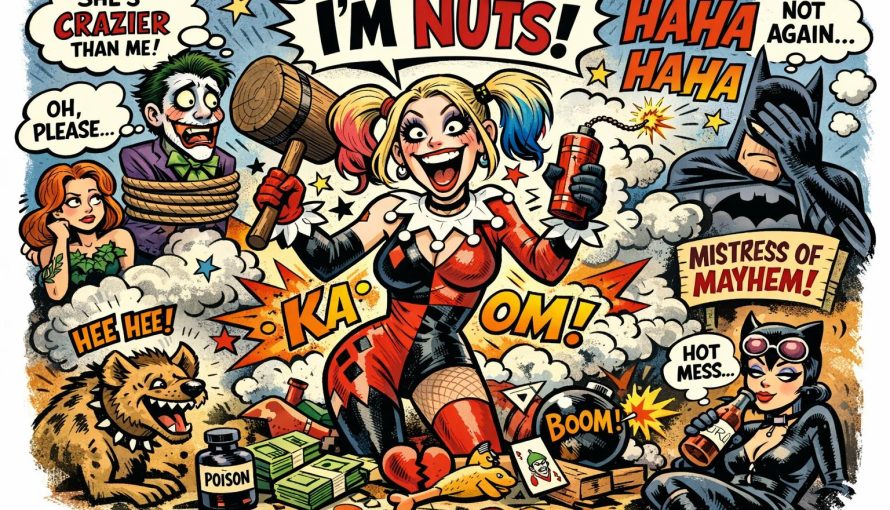
Introduction to Harley Quinn
Harley Quinn is a fictional character appearing in American comic books published by DC Comics, widely recognized for her distinctive visual style, unpredictable personality, and evolving narrative role within the broader DC Universe. Created by Paul Dini and Bruce Timm, she first appeared in Batman: The Animated Series in 1992 as a supporting character meant for a single episode. However, her popularity quickly led to recurring appearances and, eventually, integration into comic book canon. Unlike many long-established comic characters, Harley Quinn’s origins in animation rather than print distinguish her development and highlight the growing influence of television storytelling on comic book narratives.
From her earliest appearances, Harley Quinn stood out due to her combination of humor, volatility, and emotional complexity. Initially framed as a comedic counterpart to darker villains, her character gradually expanded into a more nuanced representation of identity, agency, and moral ambiguity. Over time, she transitioned from a secondary figure in Gotham City’s criminal underworld into a leading character with her own independent storylines across multiple media formats.
Character Background
Harley Quinn’s civilian identity is Dr. Harleen Frances Quinzel, a psychiatrist who interned at Arkham Asylum, Gotham City’s institution for the criminally insane. Her transformation into Harley Quinn is rooted in her professional interactions with the Joker, one of Batman’s most dangerous adversaries. During therapy sessions, Harleen becomes fascinated by the Joker’s personality, which she initially interprets through a clinical lens. Gradually, this fascination develops into emotional attachment, ultimately leading to a distorted romantic relationship.
The shift from Harleen Quinzel to Harley Quinn represents a departure from rational analysis to emotional instability. This transition is often depicted as both a personal collapse and a form of self-reinvention. Depending on the version of the story, her transformation may involve manipulation by the Joker, voluntary participation, or a combination of both. This ambiguity contributes to ongoing interpretations of her agency and responsibility.
Harley Quinn’s early characterization emphasized her role as the Joker’s accomplice, frequently assisting in his schemes while adopting a theatrical, jester-like persona. Her speech patterns, costume, and behavior reflect a blend of humor and menace, reinforcing her identity as both comic relief and a capable criminal. At the same time, her emotional dependency on the Joker introduces recurring themes of imbalance and exploitation, which later narratives examine in greater detail.
Appearances in Media
Following her debut in animation, Harley Quinn was introduced into the comic book continuity in The Batman Adventures #12 in 1993. This transition marked the beginning of her expansion across multiple storylines and publishing formats. Over time, she appeared in mainstream DC Comics titles, including those centered on Batman, Gotham City, and broader crossover events. Her growing popularity led to the launch of solo series, where writers explored her perspective independently of other central characters.
In addition to traditional comic publications, Harley Quinn has played a major role in animated films, television shows, and video games. The Batman: Arkham video game series, for instance, featured her as a recurring antagonist, contributing to her recognition among gaming audiences. Her design and personality were adapted to fit different narrative tones, ranging from darker interpretations to more comedic portrayals.
Harley Quinn’s transition into live-action film further solidified her position within mainstream pop culture. Portrayed by Margot Robbie, she first appeared in Suicide Squad (2016), where her characterization combined elements of vulnerability and aggression. Robbie reprised the role in Birds of Prey (2020), a film that focused on Harley’s independence following her separation from the Joker. In The Suicide Squad (2021), the character was further developed, emphasizing her unpredictability alongside moments of clarity and self-awareness.
The animated series Harley Quinn, which premiered in 2019, provided another reinterpretation of the character. This version focuses on her efforts to establish herself as a criminal leader separate from the Joker, blending satire with character-driven storytelling. The show examines her relationships, decision-making, and evolution in a way that differs from earlier depictions, often using humor to address serious themes.
Character Evolution
One of the most significant aspects of Harley Quinn’s history is her evolution from a supporting character to a central figure. Initially defined by her relationship with the Joker, she has gradually been portrayed as an independent individual capable of forming her own identity and motivations. This shift reflects broader changes in storytelling priorities, with increasing emphasis on character autonomy and psychological depth.
In early stories, Harley Quinn’s actions were closely tied to the Joker’s plans, and her personality revolved around gaining his approval. Over time, writers began to explore the consequences of this dynamic, particularly its imbalance and instability. These narratives often depict her recognizing the harmful nature of the relationship and attempting to distance herself from it. This process is not always linear, as setbacks and contradictions remain part of her portrayal.
Modern interpretations often position Harley Quinn as an anti-heroine rather than a straightforward villain. In this role, she may oppose greater threats while still engaging in morally questionable behavior. Her alliances vary widely, including partnerships with characters such as Poison Ivy, Catwoman, and members of the Suicide Squad. These relationships contribute to her development by offering alternatives to her earlier dependency on the Joker.
Another aspect of her evolution involves changes in visual design and tone. While her original costume resembled a traditional jester outfit, later depictions introduced more practical and modern attire. These changes reflect shifts in audience expectations as well as the character’s narrative progression. The updated designs often emphasize individuality and mobility, aligning with her portrayal as a more active and self-directed figure.
Psychologically, Harley Quinn has become a vehicle for exploring themes such as identity reconstruction, ethical ambiguity, and the effects of trauma. Writers frequently depict her oscillating between chaos and clarity, making decisions that can be both impulsive and calculated. This complexity contributes to her popularity, as audiences can engage with multiple facets of her personality.
Impact and Cultural Significance
Harley Quinn’s rise from a secondary animated character to a major figure in global entertainment illustrates the fluid nature of modern intellectual properties. Her adaptability across genres and formats has allowed her to remain relevant despite shifts in audience expectations and storytelling styles. She occupies a unique position within the DC Universe, functioning as both a participant in major events and a character capable of sustaining independent narratives.
Her cultural impact extends beyond traditional media. Harley Quinn has become a recognizable symbol in cosplay, merchandise, and fan communities. Her visual identity, characterized by bold colors and distinctive styling, contributes to her widespread recognition. At the same time, interpretations of her character often reflect broader discussions about relationships, autonomy, and psychological resilience.
Critically, Harley Quinn’s portrayal has generated varied responses. Some interpretations emphasize empowerment and self-definition, while others revisit elements of her original dependency on the Joker. This range of perspectives highlights the flexibility of the character and the different thematic directions taken by creators over time. Rather than adhering to a single consistent portrayal, Harley Quinn exists as a composite of multiple interpretations shaped by different writers, artists, and performers.
Links and Further Reading
For more detailed information about Harley Quinn’s character and her role in the DC Universe, various resources are available:
– Visit the DC Comics official website for updates and publications related to Harley Quinn.
– The DC Universe Infinite offers access to an extensive library of digital comics, including Harley Quinn’s stories.
Harley Quinn’s development demonstrates how a character can evolve significantly beyond original expectations. Her ongoing presence in comics, animation, and film suggests that she will continue to adapt to new storytelling contexts while maintaining the core elements that define her identity.