Invincible
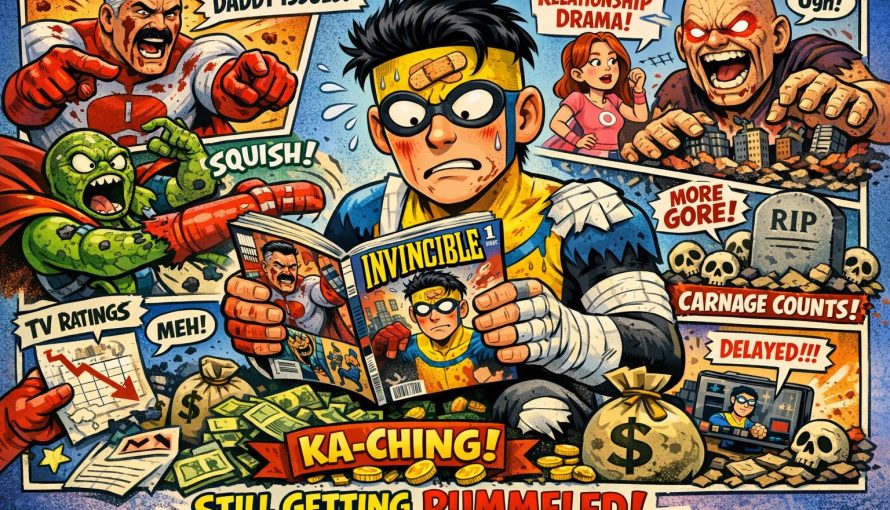
Overview of Invincible
Invincible is an American comic book series written by Robert Kirkman, with primary artwork by Cory Walker and Ryan Ottley. Published by Image Comics between 2003 and 2018, the series runs for 144 issues and represents one of the longest continuous superhero narratives outside the traditional Marvel and DC publishing systems. It follows Mark Grayson, a teenager who develops superhuman abilities inherited from his father, Nolan Grayson, also known as Omni-Man. While the premise initially mirrors familiar superhero origins, the narrative quickly diverges into a more expansive and often unpredictable exploration of heroism, violence, and responsibility.
The series is known for juxtaposing classic superhero imagery with grounded character development and abrupt tonal shifts. Its long-form storytelling allows for extensive character arcs, evolving relationships, and consequences that accumulate over time. This structure distinguishes Invincible from many episodic or reset-driven superhero comics.
Background and Publication
Robert Kirkman began Invincible as part of a broader initiative to develop creator-owned properties under Image Comics, a publisher known for granting authors and artists control over their work. Initially introduced as a backup feature in Tech Jacket #1, the concept resonated with readers and quickly transitioned into a standalone series. The first issue of Invincible was released in January 2003.
The creative team evolved over time. Cory Walker co-created the series and provided the initial visual identity, including character designs that would persist throughout the run. Ryan Ottley later assumed primary art duties and became closely associated with the series’ distinctive visual style, particularly its dynamic action sequences and expressive character work. Colorists and letterers also played significant roles in shaping the tone, with vibrant palettes contrasting sharply against depictions of physical conflict.
Publication continued consistently for fifteen years, concluding in February 2018 with issue 144. The series maintained a steady release schedule, which contributed to reader engagement and the development of a cohesive long-term narrative. Collected editions, including trade paperbacks and hardcover compendiums, helped expand accessibility and introduced new audiences to the series after its initial release.
Narrative Structure and World-Building
The story begins with a relatively contained focus on Mark Grayson’s life as a high school student, but it gradually expands into a broader universe populated by numerous heroes, villains, and extraterrestrial civilizations. Kirkman constructs a layered setting that includes government agencies, superhero teams, and interplanetary politics. Over time, the scope extends beyond Earth, incorporating complex conflicts involving the Viltrumite Empire and other alien species.
Unlike many traditional superhero worlds that rely on static continuity, Invincible emphasizes progression. Characters age, relationships evolve, and past events have lasting repercussions. Injuries and destruction are not easily reversed, and the narrative allows for irreversible changes. This approach reinforces a sense of realism within an otherwise fantastical setting.
The pacing varies across arcs, alternating between character-driven segments and large-scale conflicts. Early issues focus on Mark’s adaptation to his abilities and responsibilities, while later arcs delve into political intrigue, warfare, and ethical dilemmas that extend beyond personal concerns.
Main Characters
Mark Grayson / Invincible: Mark serves as the central figure of the series. As he develops his powers, he also confronts the challenges of maintaining personal relationships, pursuing education, and understanding his place in a world filled with threats. His character evolves significantly over time, shifting from an inexperienced teenager to a more capable and reflective individual. His decisions often carry substantial consequences, shaping both his personal life and the broader world.
Nolan Grayson / Omni-Man: Nolan is introduced as Earth’s most powerful protector and a model superhero figure. However, his true origins as a Viltrumite—members of a militaristic extraterrestrial race—introduce a central conflict that redefines the narrative. Nolan’s relationship with Mark is complex, encompassing elements of mentorship, ideological conflict, and familial duty. His actions have lasting implications that influence the direction of the entire series.
Atom Eve: Samantha Eve Wilkins, known as Atom Eve, possesses the ability to manipulate matter at a fundamental level. Her powers distinguish her from many other characters, allowing for both offensive capabilities and constructive applications. Eve’s storyline explores independence, identity, and the practical use of power beyond combat. Her relationship with Mark develops gradually and serves as a consistent element throughout the series.
Supporting Characters: The series features an extensive cast, including members of the Teen Team and later iterations of the Guardians of the Globe. Characters such as Rex Splode, Robot, Monster Girl, and Allen the Alien contribute to various subplots and thematic explorations. Each supporting figure is given narrative attention, often undergoing development that parallels or intersects with Mark’s journey.
Major Themes
Invincible incorporates several recurring themes that extend beyond standard superhero narratives. One central focus is the concept of maturation. Mark’s progression from adolescence to adulthood is depicted with attention to both internal and external changes. His increasing responsibilities and exposure to conflict shape his worldview and decision-making.
Family dynamics are another significant element. The relationship between Mark and Nolan forms the foundation for many of the series’ central conflicts. This dynamic examines the tension between inherited identity and personal choice. Additional family relationships, including those involving Eve and other characters, reinforce the importance of interpersonal connections within the narrative.
The series also addresses the ethical implications of power. Characters frequently encounter situations in which the use of force raises moral questions. Decisions are rarely presented as entirely correct or incorrect, and outcomes often involve unintended consequences. This ambiguity contributes to a more nuanced portrayal of heroism.
Violence is depicted with a level of explicit detail that contrasts with the visual style. Rather than presenting conflict as abstract or sanitized, Invincible often emphasizes the physical and emotional impact of combat. This approach reinforces the stakes involved and underscores the risks associated with superhuman abilities.
Another theme involves the concept of legacy. Characters are influenced by predecessors, mentors, and cultural expectations. The Viltrumite Empire, in particular, represents a rigid interpretation of strength and dominance, challenging Mark’s attempts to define his own values. The tension between tradition and change is explored through both individual and collective narratives.
Artistic Style and Visual Identity
The artwork plays a critical role in establishing the tone of Invincible. Cory Walker’s initial designs emphasize clarity and accessibility, aligning with the series’ early focus on a traditional superhero aesthetic. As the narrative progresses, Ryan Ottley’s contributions introduce a more detailed and kinetic approach, particularly in action sequences.
Character expressions and body language are used to convey emotional nuance, supporting the series’ emphasis on personal relationships. The depiction of motion and impact enhances the intensity of combat scenes, while the use of color provides contrast between ordinary environments and extraordinary events.
The visual consistency across issues contributes to the overall cohesion of the series, despite changes in artistic personnel. This consistency reinforces the continuity of the narrative and supports reader immersion.
Adaptations
In March 2021, Invincible was adapted into an animated television series for Amazon Prime Video. Developed by Simon Racioppa, the adaptation closely follows the structure of the comic while making adjustments to pacing and character introductions. Steven Yeun voices Mark Grayson, with additional cast members including J.K. Simmons as Omni-Man and Sandra Oh as Debbie Grayson.
The animated format allows for a direct translation of the comic’s visual intensity, particularly in action sequences. The series has been recognized for maintaining the thematic depth of the source material while adapting it for a different medium. Voice acting and narrative fidelity have been highlighted as key strengths.
Subsequent seasons continue to adapt later arcs, introducing new characters and expanding the narrative scope. The adaptation has also contributed to renewed interest in the original comics, leading to increased sales and broader recognition.
The official Image Comics page offers additional details about the series: Visit Image Comics’ Invincible Series Page.